Indonesia's Residential Property Market Analysis 2026
Indonesia's residential property market has moved from stagnation to outright decline, with house prices now falling in real terms across every major city, sales collapsing, and the central bank forced into an abrupt reversal from rate cuts to rate hikes.
This extended overview from the Global Property Guide presents a comprehensive analysis of Indonesia's housing market, covering its overall structure, price movements, demand and supply dynamics, and regulatory environment, while placing particular emphasis on recent developments and long-term trends shaping the sector.
Table of Contents
- Property Prices and Price Index
- Historic Perspective
- Property Demand Trends
- Property Supply Trends
- Rental Market: Rents and Rental Yields
- Mortgage Market and Interest Rates
- Economic and Social Factors
Property Prices and Price Index
In the first quarter of 2026, Indonesia's Residential Property Price Index (RPPI) stood at 110.60, growing by a minimal 0.62% from a year earlier, according to the country's central bank, Bank Indonesia. That followed year-on-year growth of 0.83% in Q4 2025, 0.84% in Q3 2025, 0.90% in Q2 2025, and 1.07% in Q1 2025, and marks the weakest reading in the modern history of the series.
Indonesia's house price annual change:
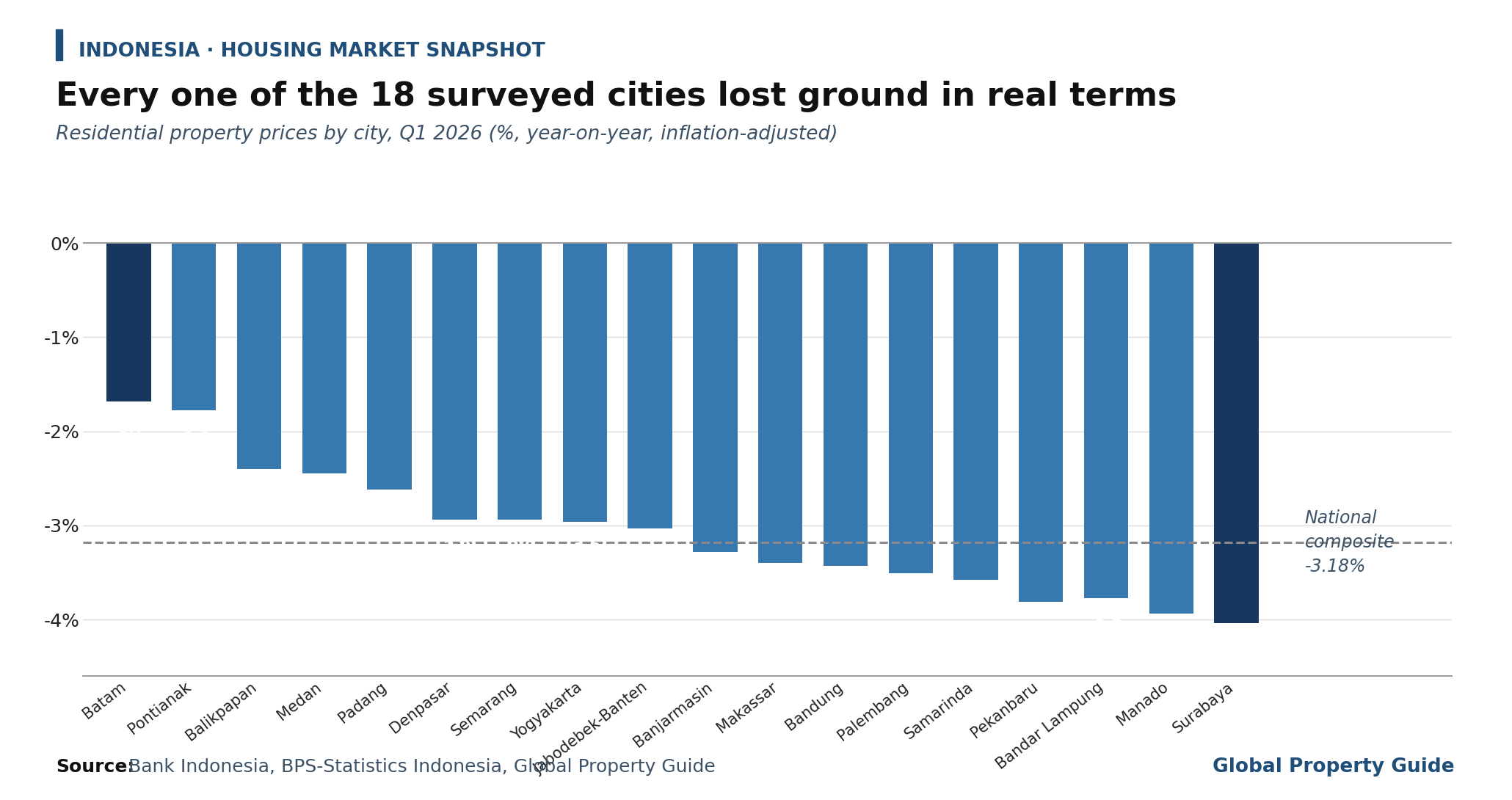
The nominal figure understates how much ground the market is losing. With consumer prices rising by an average of 3.93% during the quarter, based on figures from BPS-Statistics Indonesia, nationwide residential property prices fell by 3.18% in real terms in Q1 2026. That is the steepest inflation-adjusted decline since the first quarter of 2023 and a sharp deterioration from the 1.98% real drop recorded in the previous quarter.
Quarter-on-quarter, nominal prices were essentially flat, rising by just 0.04% in Q1 2026 after 0.17% growth in Q4 2025. In real terms, prices fell by 0.89% over the quarter.
"According to the latest Residential Property Price Survey conducted by Bank Indonesia, residential property prices in the primary market recorded limited growth in the first quarter of 2026," said the central bank in its Residential Property Price Survey for Primary House Q1 2026 report.
The moderation was broad-based across unit sizes. Prices of medium residential units, which had been the market's strongest segment, grew by 0.88% year-on-year in Q1 2026, down from 1.12% in the previous quarter, with the index at 113.56. Large units posted 0.50% growth, down from 0.72%, with the index at 108.14. Small units slowed to 0.61% from 0.76%, with the index at 113.91.
Regionally, of the 18 cities surveyed, 10 recorded slower annual growth and three registered outright nominal contractions. Once inflation is taken into account, however, not a single one of the 18 cities recorded a real house price increase in Q1 2026.
Among the notable movers, house prices in Banjarmasin grew by just 0.52% year-on-year, down sharply from 1.63% in the previous quarter, while Surabaya's contraction deepened to 0.27% from 0.04%. Working in the other direction, growth accelerated in Padang and Balikpapan, from 0.17% and 0.43% respectively in Q4 2025 to 1.21% and 1.44% in Q1 2026.
On a quarterly basis, the sharpest declines came in Pontianak and Yogyakarta, where prices fell by 0.74% and 0.68%, respectively, after growing by 0.56% and 0.18% in the previous period.
| RESIDENTIAL PROPERTY PRICES IN INDONESIA'S MAJOR CITIES, Q1 2026 | ||||
| Y-O-Y Change (%) | Q-O-Q Change (%) | |||
| Major Cities | Nominal | Real | Nominal | Real |
| Bandung | 0.37 | -3.43 | 0.01 | -0.92 |
| Bandar Lampung | 0.01 | -3.77 | 0.00 | -0.93 |
| Banjarmasin | 0.52 | -3.28 | 0.08 | -0.85 |
| Denpasar | 0.87 | -2.94 | 0.00 | -0.93 |
| Palembang | 0.28 | -3.51 | 0.02 | -0.91 |
| Semarang | 0.87 | -2.94 | 0.12 | -0.81 |
| Yogyakarta | 0.85 | -2.96 | -0.68 | -1.60 |
| Padang | 1.21 | -2.62 | 1.08 | 0.14 |
| Medan | 1.38 | -2.45 | 0.10 | -0.83 |
| Makassar | 0.40 | -3.40 | 0.03 | -0.90 |
| Manado | -0.16 | -3.94 | -0.12 | -1.05 |
| Surabaya | -0.27 | -4.04 | -0.01 | -0.94 |
| Pontianak | 2.08 | -1.78 | -0.74 | -1.66 |
| Batam | 2.18 | -1.68 | 0.17 | -0.76 |
| Balikpapan | 1.44 | -2.40 | 1.08 | 0.14 |
| Jabodebek-Banten | 0.78 | -3.03 | 0.04 | -0.89 |
| Pekanbaru | -0.03 | -3.81 | 0.00 | -0.93 |
| Samarinda | 0.21 | -3.58 | 0.11 | -0.82 |
| Composite (18 Cities) | 0.62 | -3.18 | 0.04 | -0.89 |
| Data Sources: Bank Indonesia, BPS-Statistics Indonesia, Global Property Guide. | ||||
Looking at long-term trends, the market has barely moved. The composite index sits at 110.60 against a 2018 base of 100, a nominal gain of about 10.6% over eight years. Over the same period, consumer prices rose by roughly a fifth, meaning that in real terms, Indonesian house prices are close to a tenth below where they stood in 2018.
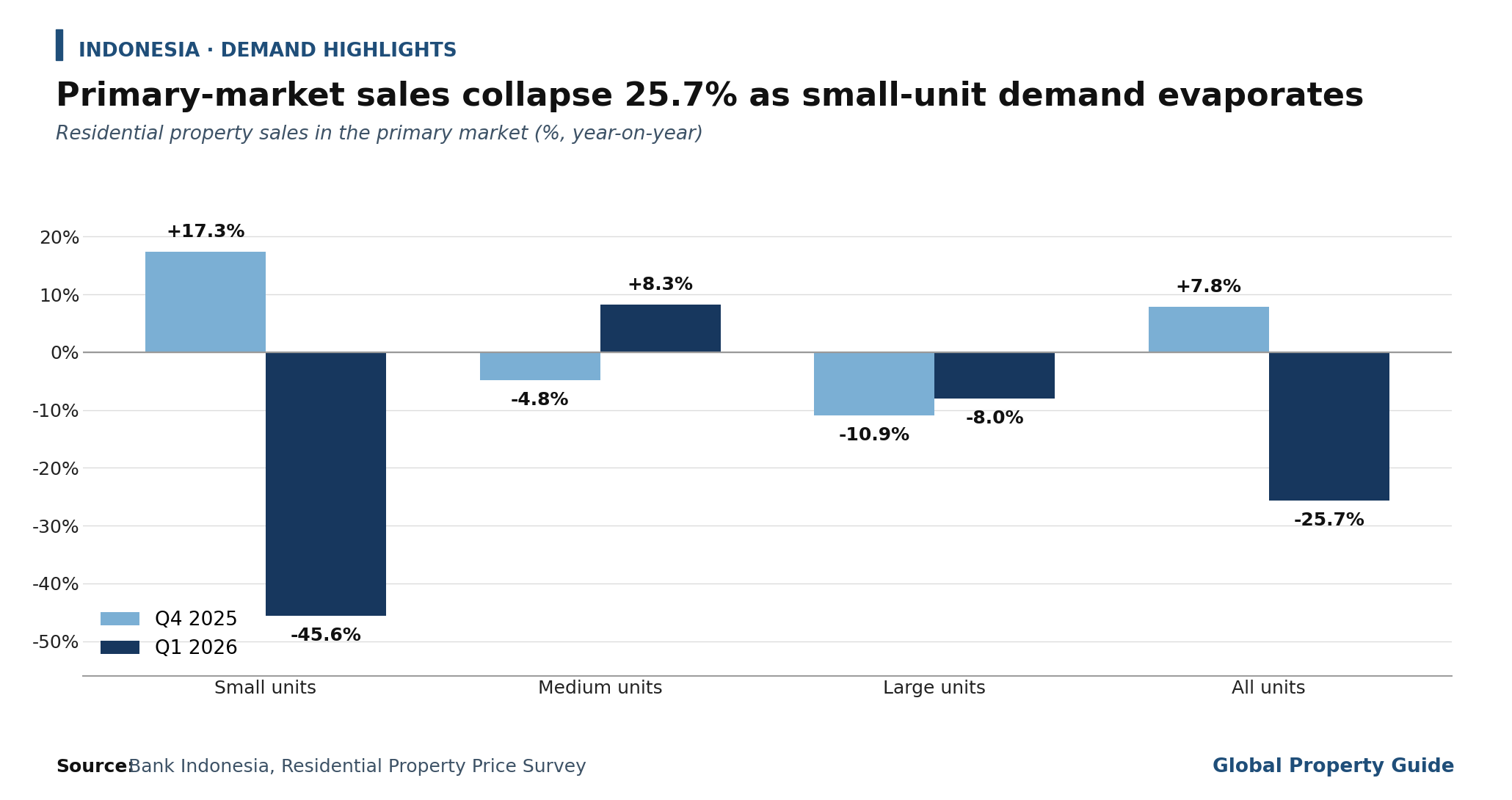
Demand has deteriorated markedly. Residential property sales in the primary market contracted by 25.67% year-on-year in Q1 2026, reversing 7.83% growth in Q4 2025 and marking the sharpest fall recorded in years. The collapse was driven almost entirely by small residential units, sales of which fell by 45.59% after posting 17.32% growth in the previous quarter.
On the supply side, Jakarta's apartment market has entered what Colliers describes as a structural adjustment phase. Only 192 new strata-title units were added in the first quarter of 2026, bringing the cumulative stock to around 233,000 units, with annual growth of less than 3%.
The wider economy, by contrast, is performing strongly on paper. Indonesia's GDP grew by 5.61% year-on-year in Q1 2026, according to BPS-Statistics Indonesia, the fastest pace since the third quarter of 2022 and comfortably ahead of the 5.11% recorded for full-year 2025. Yet that headline strength sits alongside a currency at record lows, an unexpected shift to monetary tightening, and a sharp slide in the government's approval ratings.
Historic Perspective
Jakarta's apartment prices remain broadly stable
Jakarta's apartment prices have been effectively frozen for several years. In the most recent detailed breakdown published by Colliers International, covering Q3 2025, apartment prices in the capital rose by a meager 0.8% year-on-year to approximately IDR36 million per sqm, and by 0.2% quarter-on-quarter.
Colliers reported in its Q1 2026 Jakarta apartment review that "amid modest demand, average prices remain relatively stable across almost all areas," leaving the Q3 2025 price structure broadly representative of the market through the first half of 2026.
| AVERAGE APARTMENT PRICES IN JAKARTA, Q3 2025 | ||||
| Area | Average price (IDR/sqm) | Average price (USD/sqm) | y-o-y change | q-o-q change |
| CBD | 53,443,446 | 3,183 | 1.0% | 0.4% |
| East Jakarta | 22,047,312 | 1,313 | 1.5% | 0.8% |
| North Jakarta | 27,118,775 | 1,615 | 1.1% | 1.1% |
| Central Jakarta | 36,737,618 | 2,188 | 0.0% | 0.0% |
| West Jakarta | 28,361,773 | 1,689 | 0.2% | -0.1% |
| South Jakarta | 40,735,783 | 2,426 | 0.6% | 0.0% |
| Overall | 35,995,013 | 2,144 | 0.8% | 0.2% |
| Data Sources: Colliers International, Global Property Guide. | ||||
Over the same period:
- In Jakarta CBD, the average price of strata title apartments rose slightly by 1% y-o-y to IDR53.44 million per sqm.
- In East Jakarta, prices increased by 1.5% y-o-y to an average of IDR22.05 million per sqm.
- In North Jakarta, the average price rose by 1.1% y-o-y to IDR27.12 million per sqm.
- In Central Jakarta, prices were unchanged at IDR36.74 million per sqm.
- In West Jakarta, prices increased slightly by 0.2% y-o-y to an average of IDR28.36 million per sqm.
- In South Jakarta, prices rose by a meager 0.6% y-o-y to IDR40.74 million per sqm.
The dollar picture is considerably less flattering than the rupiah picture. The USD conversions above reflect an exchange rate of roughly IDR16,800 to the dollar. At the rate prevailing in late July 2026, closer to IDR17,900, the same overall Jakarta price of IDR35.99 million per sqm translates to about USD2,010 per sqm rather than USD2,144. For dollar-based investors, Indonesian residential property has become materially cheaper over the past year without prices moving at all in local currency.
Colliers also notes that geopolitical tensions are now feeding into the cost base, warning that escalating conflict is "likely to drive up material prices and have a further impact on construction costs."
Property Demand Trends
Demand collapses in early 2026
The gradual softening seen through 2025 gave way to an abrupt contraction at the start of 2026. Residential property sales in the primary market fell by 25.67% year-on-year in Q1 2026, a dramatic reversal from the 7.83% growth posted in Q4 2025, according to figures from Bank Indonesia. Quarter-on-quarter, sales fell by 7.69%, after growing by 2.01% in the previous period.
There are wide variations by property size:
- Small residential properties: sales fell by 45.59% year-on-year in Q1 2026, after posting strong 17.32% growth in the previous quarter. Quarterly, sales dropped by 14.68%, deepening the 7.43% decline recorded in Q4 2025.
- Medium houses: sales grew by 8.28% year-on-year in Q1 2026, reversing the 4.84% contraction recorded in the previous period. Quarter-on-quarter, however, sales fell by 10.72% after growing by 8.59% in Q4 2025.
- Large houses: sales continued to contract, but at a shallower 8.03% year-on-year rate after decreasing by 10.95% in the previous quarter. Quarterly, sales fell by 20.38%, following solid 31.97% growth in Q4 2025.
"In terms of sales, the latest survey indicates increasing sales of medium residential units, while sales of small and large residential units remained subdued," said Bank Indonesia.
The main constraints to development and sale of residential property in the primary market, according to the latest survey, were rising building material costs (20.97%), licensing and bureaucracy issues (18.15%), interest rates on housing loans (16.47%), high downpayment requirements (12.16%), and taxes (11.28%).
Government incentives continue to underpin what demand there is. The value-added tax borne by government scheme, known as PPN DTP, has been extended through 2026 and covers housing units priced up to IDR2 billion. According to ANTARA News, the VAT incentive will remain in effect until 2027, and is complemented by waivers of the Land and Building Acquisition Duty (BPHTB) and building approval permits (PBG).
Colliers reports that the incentive is reshaping who buys. In its Q2 2026 review, the consultancy noted that ready-stock apartments are outperforming projects under construction, with buyers placing greater weight on immediate occupancy and delivery certainty. Investors still dominate transactions, but their share has declined from pre-pandemic levels as end-user participation strengthens, a shift Colliers attributes to higher borrowing costs, modest rental yields, and the VAT incentive on completed units.
Studio apartments were the strongest-performing product in Q2 2026, reflecting a focus on affordability, while the mid-range segment recorded the strongest sales momentum. The upper segment saw softer sales as value-conscious buyers gravitated toward cheaper products.
Tourism growth stalls after a record year
Tourism, long expected to underpin the residential market in resort areas, delivered a record 2025 but has lost momentum in 2026. Indonesia welcomed 15.39 million international visitors in 2025, up 10.8% from a year earlier and comfortably ahead of the government's 14 million to 15 million target, though still below the record 16.11 million arrivals registered in 2019.
Arrivals plunged to about 4 million in 2020 and 1.56 million in 2021 during the pandemic, then recovered from 5.89 million in 2022 to 11.68 million in 2023 and 13.9 million in 2024.
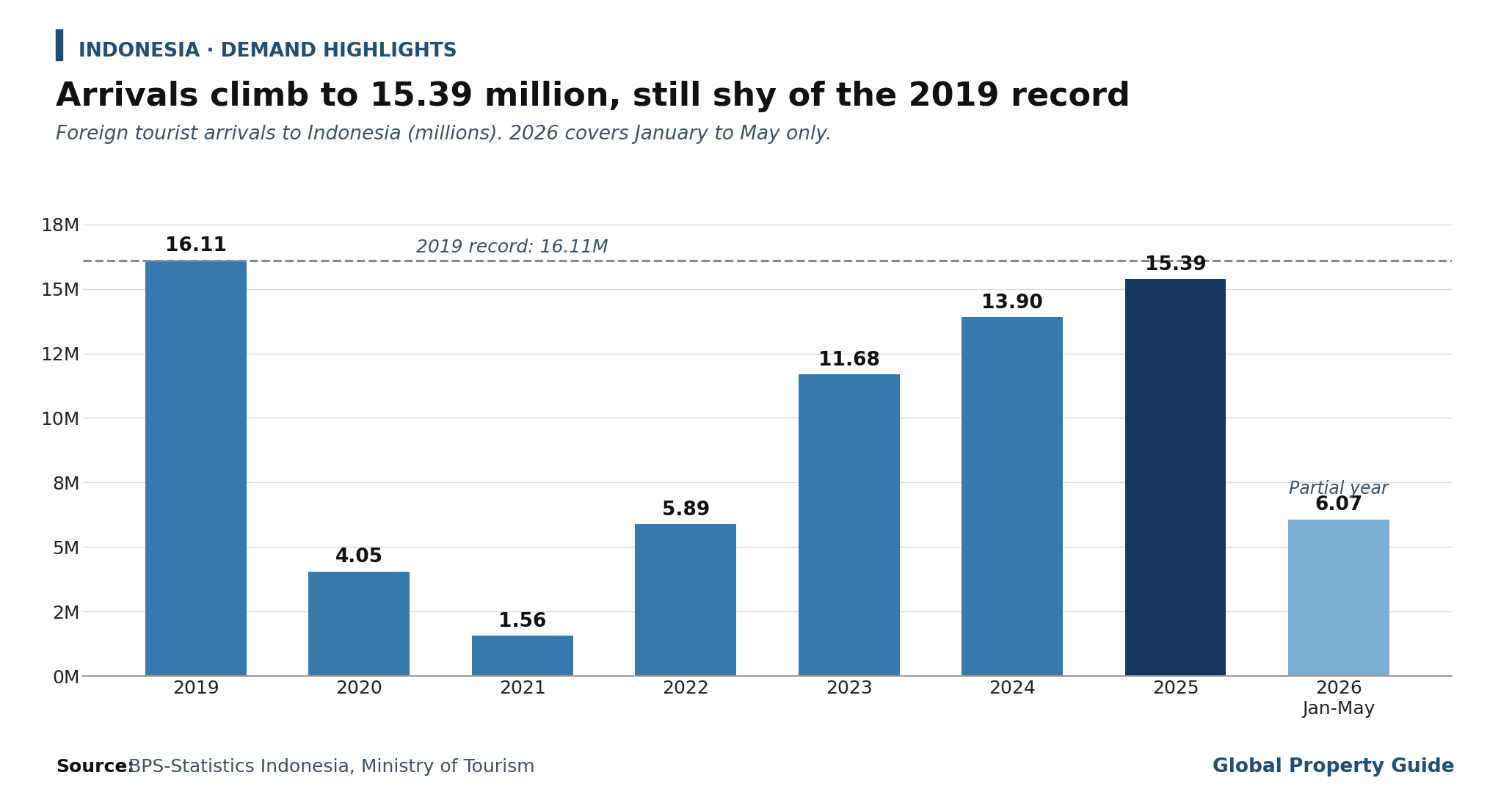
In 2026, growth has flattened. Indonesia recorded 6.07 million foreign tourist arrivals between January and May 2026, the highest figure for that period since 2020 but well short of the pace needed to hit the government's ambitious 16 million to 17.6 million target for the full year. Cumulative arrivals in the first four months reached 4.68 million, an increase of 8.24% on the same period of 2025.
Monthly figures have been volatile, falling from 1.19 million in January to 1.16 million in February and 1.09 million in March before recovering to 1.25 million in April. Malaysia remains the largest source market, followed by Australia and China.
Bali, which accounts for more than half of Indonesia's tourism foreign exchange earnings, has effectively plateaued. Foreign arrivals reached 1,466,546 in the first quarter of 2026, up just 1.04% from the same period of 2025, after reaching 6.95 million for the whole of 2025. Arrivals in April 2026 recovered to 553,328 from March, but remained 6.41% below the same month a year earlier. BPS Bali attributed the weakness partly to flight cancellations linked to the ongoing Middle East conflict.
Australia remains Bali's dominant source market, accounting for more than a quarter of arrivals in March and April 2026. Bali's tourism authority is targeting 6.63 million international arrivals for 2026.
Domestic tourism has held up better, with 523.22 million domestic trips recorded between January and May 2026, an increase of 2.86% year-on-year and the highest level since 2021.
Indonesia retains liberal foreign homeownership rules
Government Regulation No. 18 of 2021 on the Right to Manage, Right over Land, Strata Titles, and Land Registration remains the governing framework, having amended Government Regulation No. 103 of 2015. The regulation allows foreigners and foreign legal entities to own apartments in Indonesia.
However, foreigners are only able to own apartments in designated special economic zones, free trade zones, industrial estates, and other economic zones. The property must also be worth more than a minimum threshold, which differs by province under ATR/BPN Decree No. 1241/2022. In Bali, that floor is worth IDR5 billion.
Under the previous law, foreigners were only able to own land under the Right to Use land title and strata title right to use apartment units, or SHPSRS. GR 18/2021 officially allows foreigners to hold strata title rights of ownership of apartment units as well.
"Ownership rights to apartment units are granted to Indonesian citizens; Indonesian legal entities; foreigners who have permits in accordance with the provisions of laws and regulations; foreign legal entities that have representatives in Indonesia; or representatives of foreign countries and international institutions that are or have representatives in Indonesia," reads the full article 67.
Qualification for property purchases by foreign buyers has been simplified, allowing purchases using only a passport and/or visa. Previously, foreigners were required to provide proof of a limited or permanent stay permit (KITAS/KITAP). The type of titles that foreigners can hold was also upgraded from the previously limited Hak Pakai (Right to Use) to Hak Guna Bangunan (Right to Build). Foreigners still cannot hold a freehold Hak Milik title in their own name.
Earlier, in October 2020, the Omnibus Law on Job Creation was passed, which sought to leverage foreign property investment as one of the pillars to stimulate economic growth after the pandemic.
Before those measures, the last major liberalization came in December 2015, when GR 103/2015 allowed foreigners to own landed houses in Indonesia for a period of up to 80 years. Under the law, foreigners can purchase a landed house or an apartment under the right-of-use (hak pakai) title for an initial period of 30 years, extendable twice, by 20 years and then by another 30 years. If the foreigner or his heir leaves Indonesia to reside in another country, the ownership rights must be released or transferred to another qualifying person.
Property Supply Trends
Jakarta enters a structural supply adjustment
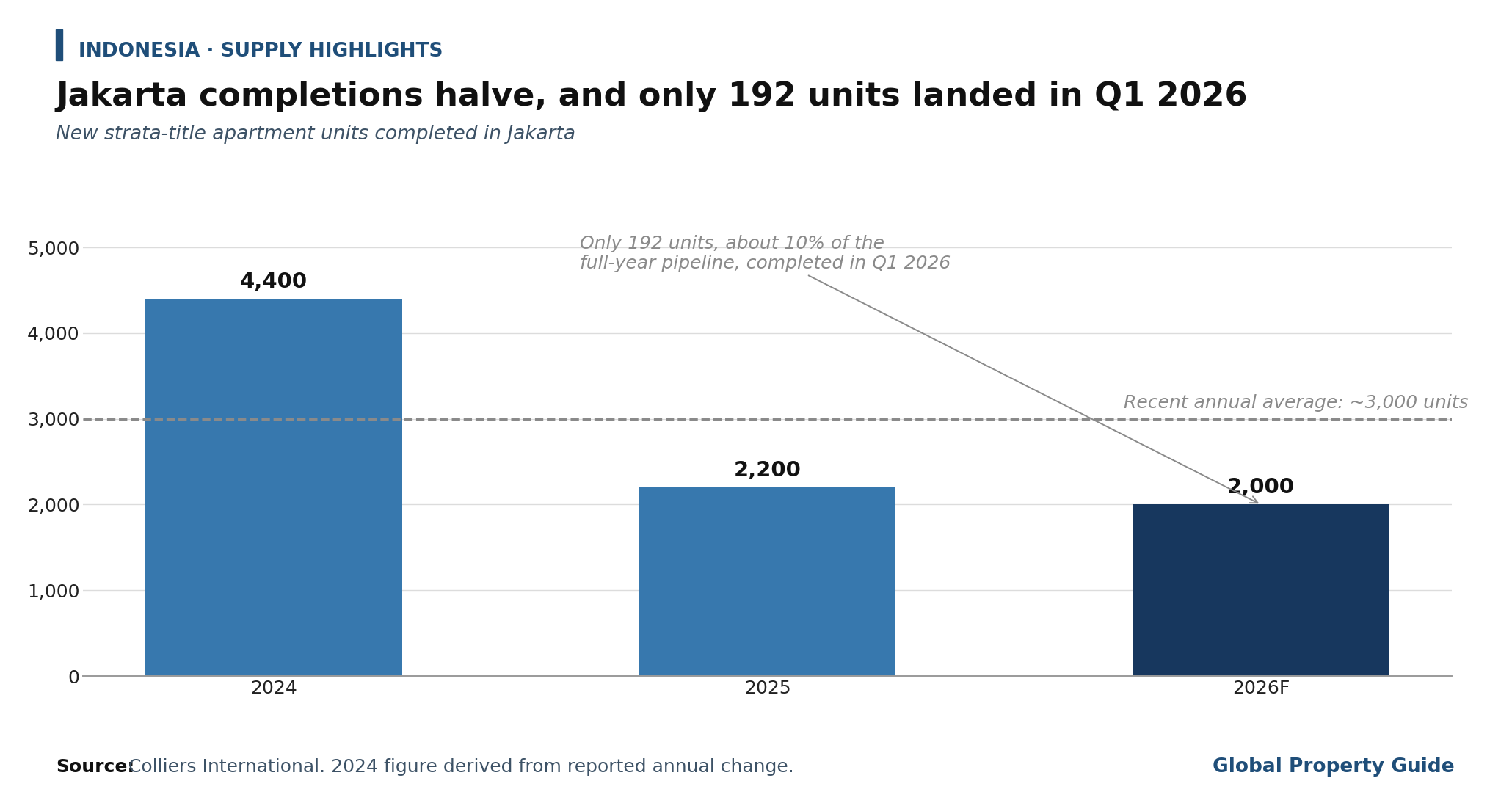
New supply in Jakarta has all but dried up. In the first quarter of 2026, only 192 new strata-title units entered the market, primarily from middle-class projects in East Jakarta, bringing the cumulative stock to approximately 233,000 units. That represents annual growth of less than 3%, extending a trend of subdued supply seen over the past five years.
That total accounted for roughly 10% of the approximately 2,000 units expected to be completed during 2026, which Colliers reads as a signal that completion timelines are slipping again. South Jakarta is expected to contribute about 60% of the total additional supply this year.
The slowdown is deliberate. Colliers describes the market as being in a "structural supply adjustment phase," with developers prioritising absorption of unsold inventory accumulated during earlier periods of aggressive expansion. Average annual additions have fallen to roughly 3,000 units in recent years, well below pre-pandemic levels.
The pipeline beyond this year is notably thin. Colliers estimates that projects scheduled for completion in 2026 could account for about 70% of total supply expected across the whole 2026 to 2029 window. The CBD is expected to add fewer than 500 units through to 2029, with limited land availability in prime areas accelerating a shift toward mixed-use developments combining residential, office, and commercial components.
For context, several projects originally scheduled for completion in Q4 2025 were delayed, with the result that Jakarta added approximately 2,200 apartment units during 2025, nearly 50% below the 2024 level, bringing total apartment supply to around 232,000 units at the end of that year.
Tapera in limbo after the Constitutional Court ruling
Indonesia's flagship housing savings scheme has been dismantled by the courts. In September 2025, the Constitutional Court annulled the 2016 Public Housing Savings (Tapera) Law in its entirety, ruling that compulsory contributions from all workers and employers imposed an unfair burden on both. The government was given two years to draft a replacement, failing which the law lapses altogether.
The scheme had required all formal workers earning at least the minimum wage to contribute 3% of their pay, 2.5% from employees and 0.5% from employers, with the contribution voluntary for private-sector companies until 2028. Those deductions no longer apply.
The consequences for housing finance are significant. The government had envisioned Tapera as a transformative financing pool, projecting collections of IDR160 trillion to IDR268 trillion from 43 million formal-sector workers by 2027. Those projections are now off the table. BP Tapera's role has shrunk to managing existing civil servant housing funds, transferred in 2020, and disbursing the government's Housing Financing Liquidity Facility (FLPP).
That matters because FLPP has been funded through a blended model combining roughly 75% capital from the state budget and 25% from Tapera-managed funds, so the ruling casts doubt on the long-term co-financing of affordable housing subsidies. BP Tapera has said it is developing a Contractual Saving for Housing concept as a possible replacement business model, with a revised Tapera law projected to be signed in 2027.
The wider "3 Million Homes" programme has also lost momentum, having been excluded from the list of National Strategic Projects under Coordinating Economy Minister's Regulation No. 16/2025.
FLPP disbursement continues despite the legal uncertainty
Subsidised lending itself has kept running. During 2025, FLPP disbursement reached 278,868 housing units, the highest level in history, with a total value of IDR34.64 trillion, though this fell short of the 350,000-unit target set for that year.
"The distribution of FLPP financing in 2025 closed at its highest level in history, reaching 278,868 housing units with a total value of Rp34.64 trillion," said BP Tapera Commissioner Heru Pudyo Nugroho.
West Java remained the largest recipient nationwide, accounting for 62,591 units or 22.44% of total distribution, followed by Central Java with 24,470 units (8.77%), South Sulawesi with 23,255 units (8.34%), Banten with 18,966 units (6.80%), and East Java with 18,361 units (6.58%).
For 2026, the government has again set a quota of 350,000 subsidised housing units. Progress has been slow: as of mid-July 2026, roughly 102,900 units had been disbursed, with BP Tapera and the Housing Ministry planning a mass signing of 62,000 subsidised mortgage contracts across around 115 locations at the end of July to accelerate the count.
To improve affordability, the Housing Ministry and BP Tapera extended the maximum installment tenor for subsidised housing from 20 years to 30 years in March 2026, following a directive from President Prabowo Subianto.
Rental Market: Rents and Rental Yields
Rental yields climb to 8.30%
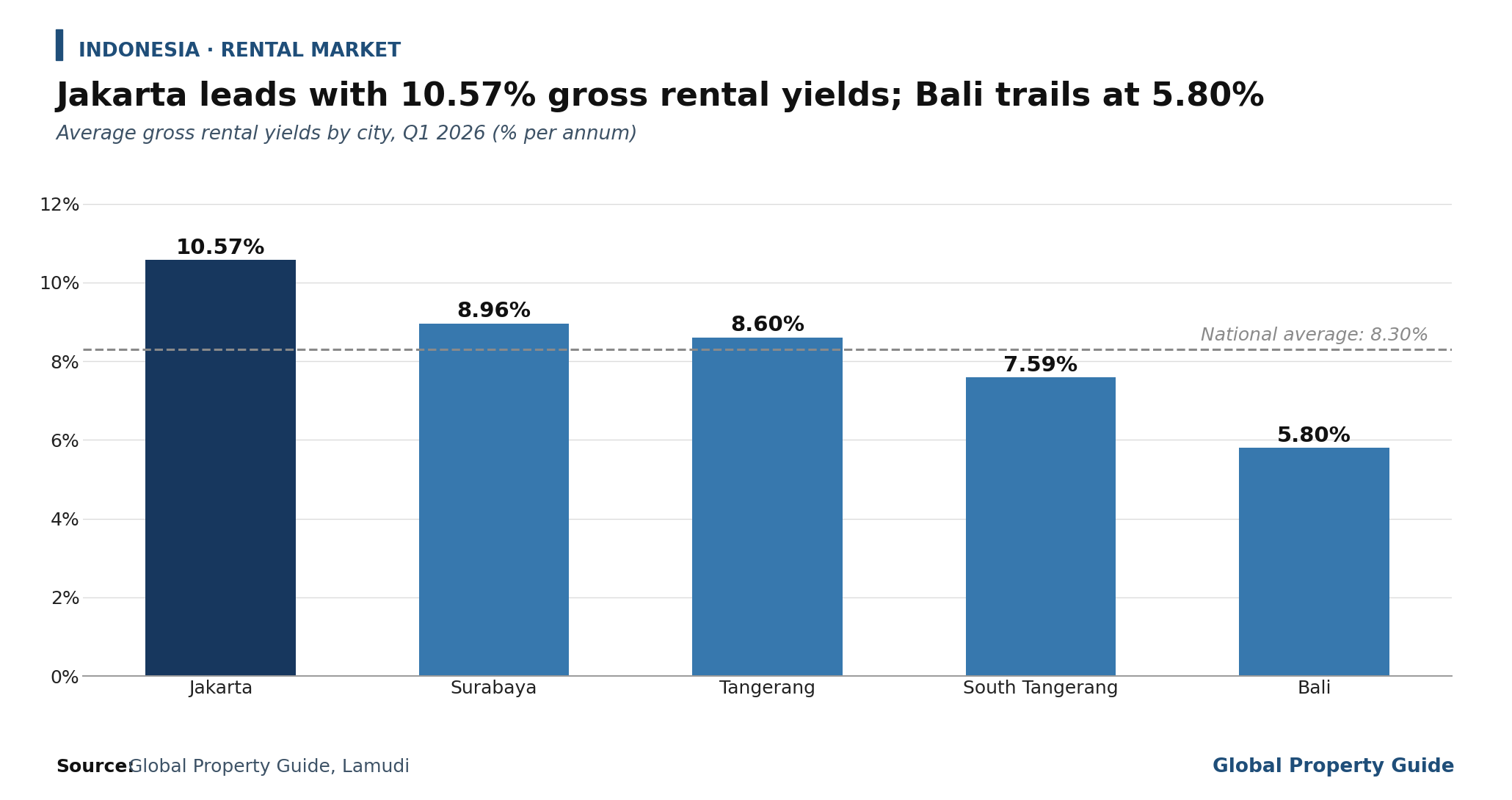
Gross rental yields in Indonesia continue to rise, reaching an average of 8.30% in Q1 2026, according to research conducted by the Global Property Guide. That is up from 7.15% in Q3 2025, 5.41% in Q2 2025, and 6.12% in Q4 2024.
The improvement reflects stagnant purchase prices rather than surging rents. With nominal prices barely moving and falling outright in real terms, the denominator in the yield calculation has stopped growing while rents have continued to drift upward.
Gross rental yields, the return earned on the purchase price of a rental property before taxation, vacancy costs, and other costs, are an important consideration because a high rental yield indicates that the property market is reasonably priced.
By major area, in Q1 2026:
- In Jakarta, gross rental yields on apartments range from as low as 4.80% to as high as 12.02%, depending on location and unit size. The city's average rental yield stands at 10.57%, the highest of any surveyed market.
- In Surabaya, apartments offer rental returns from 5.59% to 12.77%, with a city average of 8.96%.
- In Tangerang, rental yields range from 7.56% to 9.48%, with a city average of 8.60%.
- In South Tangerang, apartment rental yields range from 6.68% to 8.56%, with a city average of 7.59%.
- In Bali, gross rental yields for villas range from 4.00% to 7.59%, with a city average of 5.80%, the weakest of the five markets covered.
Bali's position at the bottom of the table is notable given the island's tourism profile, and reflects the high purchase prices villas now command relative to achievable rents.
These figures should be read alongside a materially more conservative estimate from the commercial agencies. Figures released by Colliers International showed that apartment rental yields in Jakarta have remained relatively stable over the past three years, averaging around 4%.
"Over the past three years, apartment rental yields have remained largely unchanged, stabilizing at ~4%," said Colliers.
"From a locational perspective, the CBD has consistently recorded the highest and most stable yields-4.3% over the past three years-supported by corporate tenants, expatriates, and professionals seeking premium amenities in prime locations. East Jakarta delivered the strongest yield growth, increasing from 3.1% in 2022 to 3.4% in 2024," added Colliers.
The gap between the two sets of figures is largely methodological. The Global Property Guide series compares median asking rents with median list prices drawn from a local property platform across all unit sizes, while Colliers works from its own portfolio of tracked strata-title projects, weighted toward larger and higher-specification units where yields are structurally lower.
Rents increasing gradually, occupancy rates broadly stable
Apartment rents in Jakarta have shown modest improvement. In 2025, rental rates in the CBD areas increased slightly to around IDR470,000 to IDR480,000 per square meter per month. Monthly rents in non-CBD locations also rose modestly, to about IDR410,000 to IDR420,000 per sqm over the same period.
"Rental rates for serviced apartments in Jakarta recorded limited growth in 2025, constrained by fluctuations in occupancy levels throughout the year. This trend indicates that operators continued to prioritise occupancy recovery and rental stability rather than implementing aggressive rental rate increases," said Colliers International. "Nevertheless, upward pricing adjustments may emerge as the market enters a new rental cycle in 2026."
Occupancy rates for serviced apartments in Jakarta were broadly stable in 2025, ranging from 55% to 65%.
High taxes defer property investment in Indonesia
Despite the high headline yields, property investment remains relatively unattractive for foreigners because of complex legalities and high tax rates on non-resident owners.
- The tax levied on the average annual income on a rental apartment or property in Indonesia is 20%, which is the third highest in Asia, after Bangladesh (25%) and Malaysia (22.4%).
- A 10% value-added tax is levied on gross rental income.
- Capital gains realized by individuals from the sale of real property in Indonesia are taxed at a flat rate of 5%. The tax base is the transfer value of the property, without any deductions.
- Sales of luxury houses, apartments, townhouses, and condominium units with a selling price above IDR30 billion are subject to 20% sales tax.
- Property tax is levied at 0.5% on the assessed value of the property.
The total cost of buying and then reselling a residential property, including registration costs, real estate agent fees, legal fees, sales, and transfer taxes, remains one of the highest in the region.
Mortgage Market and Interest Rates
Bank Indonesia reverses course, hiking 100bps in a month
The most consequential development for Indonesian housing finance in 2026 has been an abrupt turn in monetary policy. After cutting the BI-Rate six times between September 2024 and September 2025, taking it from 6.25% to 4.75%, and holding it there through April 2026, Bank Indonesia has raised rates by a cumulative 100 basis points in the space of a month.
The tightening came in three steps. On 20 May 2026, the Board of Governors raised the BI-Rate by 50 basis points to 5.25%. An unscheduled meeting on 9 June added a further 25 basis points to 5.50%. A scheduled meeting on 18 June took the rate to 5.75%, its highest level in over a year.
At its meeting on 21 and 22 July 2026, Bank Indonesia held the BI-Rate at 5.75%, alongside a deposit facility rate of 4.75% and a lending facility rate of 6.50%, opting instead to lean on foreign exchange incentives, liquidity measures, and market deepening to support the currency.
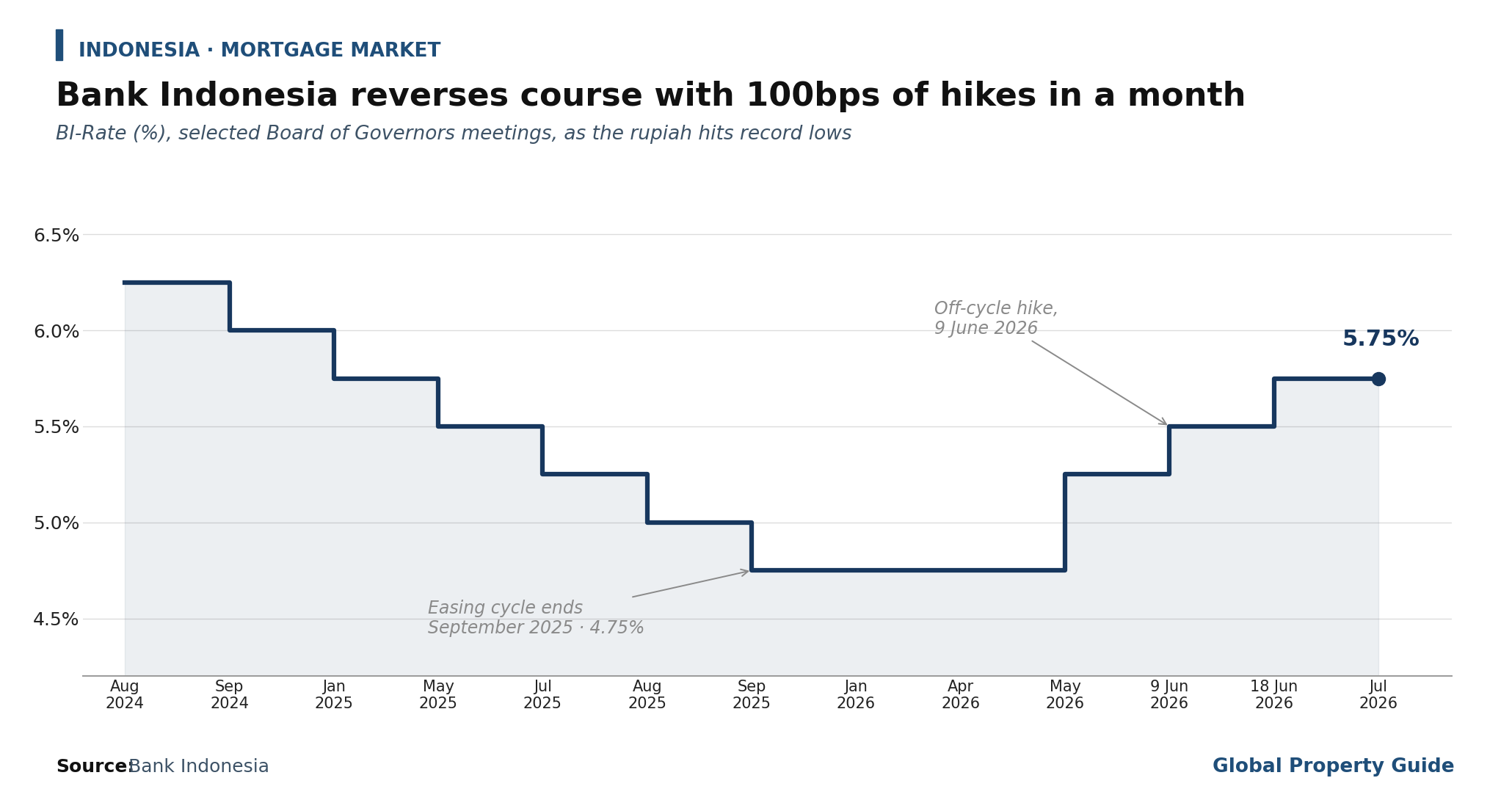
The driver throughout has been the rupiah rather than domestic demand. "The increase represents a further measure to strengthen Rupiah exchange rate stabilisation efforts against the impact of heightened global turmoil triggered by the war in the Middle East, as well as a pre-emptive measure to maintain inflation within the target corridor of 2.5±1% in 2026 and 2027 set by the Government," said Bank Indonesia in its May policy statement.
Mortgage rates have not yet caught up with the policy move. Bank Indonesia's survey recorded average mortgage rates of 7.42% in Q1 2026, unchanged from Q4 2025. Given that the survey period closed before the tightening began, borrowers should expect repricing to feed through during the second half of 2026, adding further pressure to a demand picture that is already weak.
Mortgage growth slows sharply
Housing credit growth has decelerated in step with demand. The total value of housing loans grew by 4.79% year-on-year in Q1 2026, moderating from 7.05% in the previous period, according to Bank Indonesia. On a quarterly basis, the value of housing loans grew by just 0.37%, down from 1.72% in Q4 2025.
For reference, the total amount of outstanding residential mortgage loans drawn to households, covering loans for housing, flats, and apartments, stood at IDR807 trillion in December 2025, up 6.9% year-on-year, based on figures from Bank Indonesia. By property type at that date, houses accounted for IDR774.57 trillion of outstanding loans, up 7% from a year earlier, while flats and apartments accounted for IDR32.43 trillion, up a modest 3.1%.
The average annual growth rate of residential mortgage loans has dropped substantially over time, from a robust 35.2% between 2003 and 2013 to just 9.4% per year during the 2014 to 2024 period, and to below 5% in the most recent quarter.
Mortgage credit penetration remains limited. The ratio of mortgage credits to GDP is around 3.4%, barely changed over the past decade, based on figures from the Global Property Guide.
Broader bank lending, by contrast, has been comparatively firm. Credit growth reached 11.51% year-on-year in May 2026, and Bank Indonesia projects full-year credit growth within an 8% to 12% range. To support intermediation, the central bank raised the maximum foreign funding ratio for banks from 35% to 40% of capital, effective 1 July 2026.
Developers lean even harder on internal funds
Indonesian developers continue to find external financing difficult, and the reliance on their own balance sheets has deepened. In Q1 2026, property developers relied on internal funds for 80.66% of residential development financing, up from 77.67% in Q3 2025. Bank loans accounted for 13.74% and consumer payments for 5.60%.
On the consumer side, housing loans remained the dominant financing route for primary residential purchases, accounting for 69.87% of total purchasing schemes, with cash instalments at 19.61% and outright cash purchases at 10.53%.
"In the first quarter of 2026, property developers continued to rely on internal funds as the primary source of financing residential property development, accounting for 80.66% of total financing," said Bank Indonesia.
Memories of the Asian crisis remain alive in Indonesian banking. Banks tend to be extremely cautious in extending housing loans to the real estate industry, although Indonesian banks are strong and adequately capitalized. Rising geopolitical uncertainty and currency volatility have reinforced that caution in recent quarters.
Economic and Social Factors
Headline growth accelerates even as the currency buckles
Indonesia's economy expanded by 5.61% year-on-year in the first quarter of 2026, according to BPS-Statistics Indonesia, the fastest pace since the third quarter of 2022 and well ahead of the 5.3% consensus estimate. GDP reached IDR6,187.2 trillion at current prices and IDR3,447.7 trillion at constant prices. Quarter-on-quarter, the economy contracted by 0.77%, a normal seasonal pattern.
By major component, in Q1 2026:
- Private consumption increased by 5.5% from a year ago, up from 5.1% in the previous quarter, boosted by Eid al-Fitr holiday spending.
- Government spending surged by 21.81%, following 4.5% growth in the preceding quarter, driven by Eid allowance payments and expansion of the Free Nutritious Meals programme.
- Gross fixed capital formation grew by 5.96%, supported by private investment and national priority projects.
- Net trade weakened materially, with export growth easing to 0.9% while import growth accelerated to 7.2%.
By sector, accommodation and food service activities recorded the strongest expansion at 13.14%, followed by services at 9.91%. Manufacturing, the largest contributor to GDP, grew by 5.04%. Mining continued to contract.
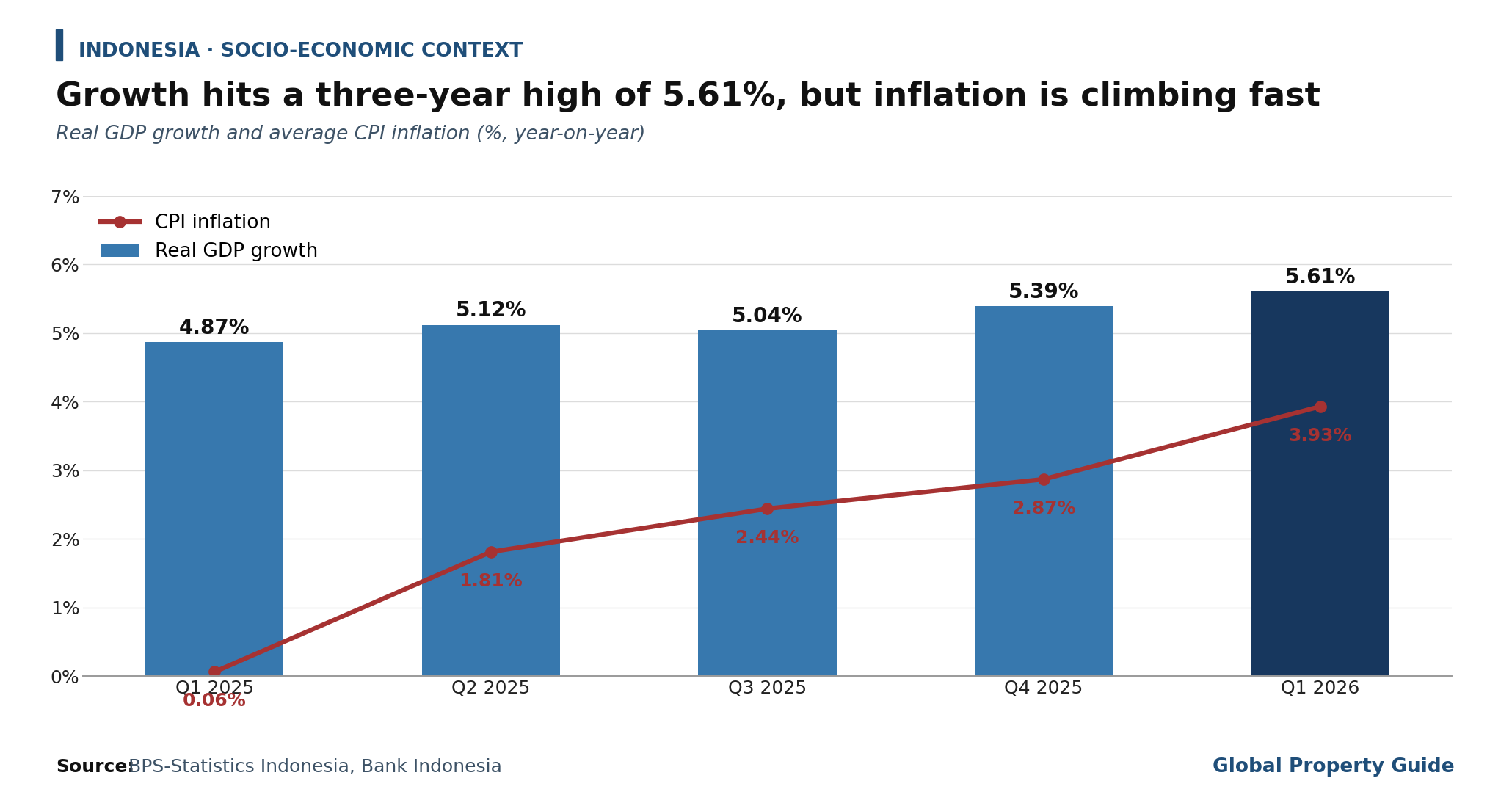
Overall, Indonesia's economy grew by 5.11% during 2025, following annual expansions of 5% in both 2023 and 2024, 5.3% in 2022, and 3.7% in 2021, and a pandemic-induced contraction of 2.1% in 2020.
Forecasts for 2026 diverge sharply. The government targets 5.4% growth, and Bank Indonesia projects around 5.3%. The IMF has been more cautious, trimming its projection to about 5.0% in its April 2026 World Economic Outlook after the Middle East energy shock, while the World Bank cut its forecast to 4.7% in its April 2026 East Asia and Pacific Economic Update, citing higher oil prices and risk-off sentiment. The Asian Development Bank sits between the two at 5.2%.
Inflation climbs on fuel prices and a weaker rupiah
Inflation has moved decisively higher. In June 2026, headline inflation reached 3.34%, up from 3.08% in May and close to the upper bound of Bank Indonesia's 1.5% to 3.5% target corridor. Core inflation quickened to 2.76%, a 38-month high, indicating that underlying price pressures are firming rather than simply reflecting one-off shocks.
The immediate trigger was fuel. On 10 June 2026, the government raised the price of Pertamax by 32.1% after soaring global oil prices put unsustainable pressure on the fiscal balance. Transport prices rose 2.29% month-on-month in June as a result.
The 2026 path has been erratic, reflecting base effects from electricity tariff discounts granted in early 2025. Inflation ran at 3.55% in January, spiked to 4.76% in February, its highest since March 2023, then eased to 3.48% in March and 2.42% in April before turning higher again.
Over a longer horizon, inflation averaged 9.5% from 2001 to 2008, fell to an annual average of 4.7% from 2009 to 2019, and dropped further to 2% in 2020 and 1.6% in 2021. It surged to 4.1% in 2022, remained elevated at 3.7% in 2023, and eased to an average of 2.3% in 2024.
Unemployment falls to its lowest level since 1997
The labour market remains a bright spot. In February 2026, the nationwide open unemployment rate was 4.68%, down from 4.76% a year earlier and the lowest level recorded since 1997, according to BPS-Statistics Indonesia. The number of unemployed edged down to 7.24 million, while employment rose 1.3% to 147.67 million.
The total labour force reached 154.91 million in February 2026, an increase of 1.862 million from a year earlier, with a labour force participation rate of 70.56%. The average monthly wage of employees was IDR3.29 million, equivalent to roughly USD184 at prevailing exchange rates, a figure that underlines how thin the affordability base for market-rate housing remains.
The rupiah breaks 18,000 for the first time
The currency has been the defining macroeconomic story of 2026. After averaging IDR16,826 to the dollar in January 2026, the rupiah slid steadily through the spring, breaching IDR17,000 in early April and reaching a record intraday low of IDR18,209 on 9 June 2026 before Bank Indonesia's emergency hike.
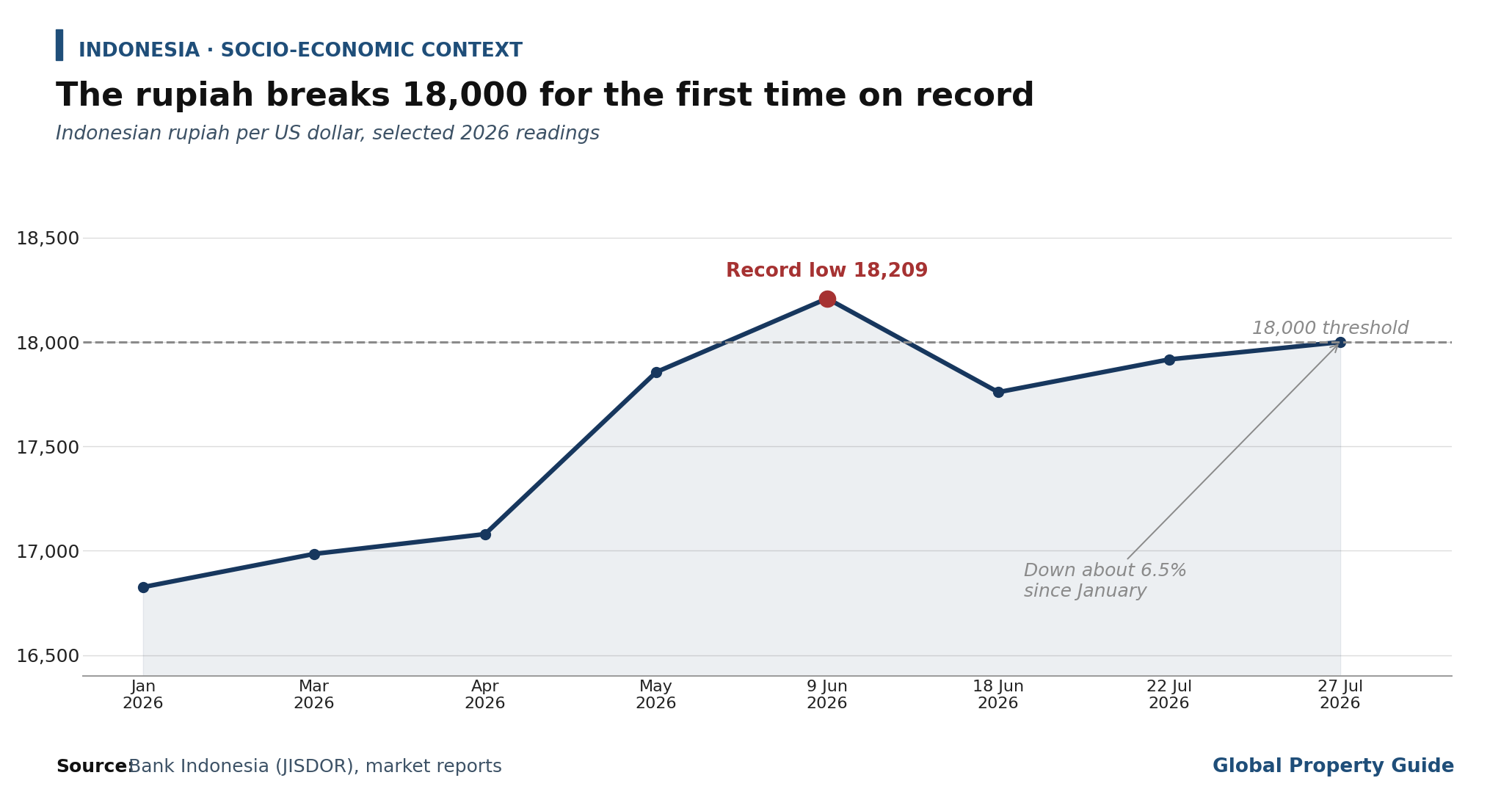
By late July 2026, the rupiah was trading around IDR17,900 to IDR18,000, leaving it down roughly 6.5% against the dollar since the start of the year. The pressure has come from a combination of global and domestic factors: the Middle East conflict and the associated oil price shock, capital outflows from emerging markets, seasonal domestic foreign exchange demand for dividend payments and external debt servicing, and persistent concerns over fiscal policy and central bank independence.
External buffers have thinned. Indonesia's overall balance of payments recorded a deficit of USD9.1 billion in a single quarter, the worst figure in more than two decades, and the country posted a trade deficit of USD1.61 billion in May 2026, ending a run of monthly surpluses stretching back to May 2020. Foreign exchange reserves stood at USD145.6 billion in June 2026, still above the international adequacy standard of around three months of imports.
Fiscal pressures narrow the government's room to manoeuvre
The fiscal deficit amounted to IDR695.1 trillion in 2025, equivalent to approximately 2.92% of GDP, wider than the government's earlier forecast of 2.76% and the widest since 2005 excluding the pandemic years. The government aims to keep the 2026 deficit below 2.8% of GDP, within the statutory 3% cap.
Government debt remains moderate at around 40% of GDP, but debt servicing is becoming a constraint. Interest payments alone are projected to reach IDR599 trillion in 2026, around 22% of projected tax revenues, while the government continues to fund large-scale initiatives including the Free Nutritious Meals programme.
The rating agencies have taken note without acting on the grade itself. On 5 February 2026, Moody's affirmed Indonesia at Baa2 but revised the outlook to negative, citing "reduced predictability in policymaking, which risks undermining policy effectiveness and points to weakening governance." Fitch followed with a similar outlook revision on 4 March 2026, while S&P affirmed Indonesia at BBB with a stable outlook on 13 July 2026, describing the current fiscal strains as temporary. Indonesia remains two notches above sub-investment grade at all three agencies.
Prabowo's approval collapses as economic sentiment sours
President Prabowo Subianto, who was sworn in on 20 October 2024 alongside Vice President Gibran Rakabuming Raka after a decisive victory in the February 2024 elections, has seen his political position deteriorate sharply during 2026.
Public satisfaction with the President's performance fell to 51.1% in July 2026, according to a survey conducted by Saiful Mujani Research and Consulting between 5 and 19 July. That extends a steep downward trend from 81.2% in November 2025 and 66.4% in March 2026. Dissatisfaction rose to 46.9%, up from 16% in November 2025.
The survey pointed squarely at the economy. Nearly half of respondents, 49.4%, described economic conditions as bad or very bad, against just 15.7% describing them as good, down from 40% in November.
Prabowo took office promising to accelerate annual GDP growth from 5% to 8% and to stamp out corruption. His administration has since launched a series of high-impact and contested policies, including a nationwide expansion of free school meals, a large budget reallocation, and the creation of the Danantara sovereign wealth fund. His predecessor Joko Widodo had built his reputation on infrastructure, with 190 national strategic projects completed between 2016 and 2023 at a total value of IDR1,515.4 trillion.
Central bank leadership changes unexpectedly
Adding to the uncertainty, Bank Indonesia Governor Perry Warjiyo resigned on 27 July 2026, two years before the end of his second term, citing personal reasons. Senior Deputy Governor Destry Damayanti was appointed acting governor pending a permanent nomination by the President and approval by parliament.
The resignation rattled markets, though modestly, with the rupiah weakening about half a percent on the day and the IDX Composite index closing 0.17% lower. Analysts have framed the episode as a test of the central bank's institutional independence, particularly given that parliament recently passed legislation strengthening its ability to make binding recommendations to independent financial regulators and to Bank Indonesia. The change follows the removal of Finance Minister Sri Mulyani Indrawati in 2025, who was replaced by Purbaya Yudhi Sadewa.
For the housing market, the implications are indirect but real. Policy credibility shapes the risk premium embedded in the rupiah, which in turn drives the interest rate path that determines mortgage affordability. A residential market already contending with falling real prices, collapsing sales, and a supply pipeline in deliberate retreat now faces an additional layer of institutional uncertainty.
Sources:
- Residential Property Price Survey for Primary House Quarter I-2026 (Bank Indonesia): https://www.bi.go.id/
- BI-Rate Increased by 50 bps to 5.25% (Bank Indonesia): https://www.bi.go.id/
- BI Rate rises to 5.75%, highest since April 2025 (IDNFinancials): https://www.idnfinancials.com/
- BI Rate held at 5.75% after 100 bps of hikes since the start of 2026 (IDNFinancials): https://www.idnfinancials.com/
- CPI Inflation in June 2026 Remains Under Control (Bank Indonesia): https://www.bi.go.id/
- Year-on-year headline inflation in June 2026 was 3.34 percent (BPS-Statistics Indonesia): https://www.bps.go.id/
- Year-on-year headline inflation in March 2026 was 3.48 percent (BPS-Statistics Indonesia): https://www.bps.go.id/
- Indonesia's Economic Growth in Q1-2026 was 5.61 Percent (BPS-Statistics Indonesia): https://www.bps.go.id/
- Unemployment Rate was 4.68 percent and the average wage of employees was 3.29 million rupiah (BPS-Statistics Indonesia): https://www.bps.go.id/
- Colliers Quarterly Property Market Report Q1 2026 Jakarta Apartment (Colliers International): https://www.colliers.com/
- Jakarta strata-title apartment stock inches up by around 3% in Q1 (Real Estate Asia): https://realestateasia.com/
- Ready-stock apartments outperform in Jakarta as owner-occupiers gain ground (Real Estate Asia): https://realestateasia.com/
- Mid-range apartments lead Jakarta sales as buyers become more selective (Real Estate Asia): https://realestateasia.com/
- Jakarta apartment market finds stability amid limited new supply (Colliers International): https://marcom.colliers365.com/
- Momentum builds in Jakarta's apartment market as buyers flock to ready units (Colliers International): https://marcom.colliers365.com/
- Gross rental yields in Indonesia: Jakarta and 4 other cities (Global Property Guide): https://www.globalpropertyguide.com/
- Tapera in limbo after Constitutional Court strikes down law (The Jakarta Post): https://www.thejakartapost.com/
- Analysis: Tapera law annulment exposes flaws in Indonesia's housing strategy (The Jakarta Post): https://www.thejakartapost.com/
- Indonesia's FLPP housing financing hits record in 2025 (Antara News): https://en.antaranews.com/
- Indonesia announces 30-year tenor for subsidized housing (Antara News): https://en.antaranews.com/
- End of July 2026, BP Tapera Will Provide 62,000 Subsidized Houses (VOI): https://voi.id/
- Indonesia's Omnibus Law: Relaxed Foreign Ownership Laws on Real Estate (ASEAN Briefing): https://www.aseanbriefing.com/
- New regulation expands strata title rights for foreign citizens and legal entities (UN Trade and Development): https://investmentpolicy.unctad.org/
- Indonesia eases foreign home ownership, but only for high earners (Asia News Network): https://asianews.network/
- Indonesia exceeds 2025 tourism target with 15.39 million visitors (Antara News): https://en.antaranews.com/
- Indonesia welcomes 6.07 million foreign tourists in Jan-May, highest since 2020 (Indonesia Expat): https://indonesiaexpat.id/
- Foreign Tourist Arrivals Increase 1.4% in Q1 2026 (Bali Discovery): https://balidiscovery.com/
- Indonesia inflation review: fuel shock and weak rupiah drive June price pressures (Indonesia Investments): https://www.indonesia-investments.com/
- Indonesia posts first trade deficit in six years as June inflation rises to 3.34% (Business Indonesia): https://business-indonesia.org/
- Indonesia's Rupiah Crisis: Why the Currency Fell Past Rp18,000 per US Dollar (The Southeast Asia Desk): https://www.thesoutheastasiadesk.com/
- Indonesia's budget squeeze multiplies monetary policy dilemmas (East Asia Forum): https://eastasiaforum.org/
- Moody's Ratings changes Indonesia's outlook to negative, affirms Baa2 (Moody's Ratings): https://ratings.moodys.com/
- World Bank Cuts Indonesia's 2026 Growth Forecast to 4.7% (Tempo): https://en.tempo.co/
- Prabowo's approval rating sinks amid dissatisfaction with economy, politics (The Jakarta Post): https://www.thejakartapost.com/
- Bank Indonesia Governor Perry Warjiyo resigns (Antara News): https://en.antaranews.com/
- Who is Prabowo Subianto, the former general who becomes Indonesia's new president? (Associated Press): https://apnews.com/
- Jokowi's 190 Strategic Projects Completed Throughout 2016-2023 (Tempo English): https://en.tempo.co/
- Indonesia (International Monetary Fund): https://www.imf.org/